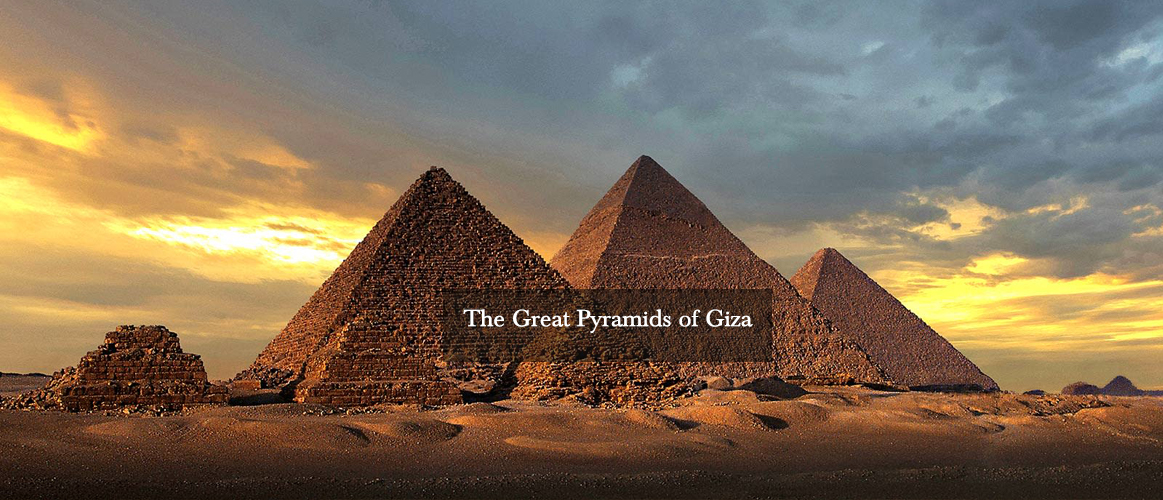

The Great Pyramids of Giza
WELCOME TO THE
EGYPTIAN The pyramids of Giza
The pyramids of Giza and the Great Sphinx are among the most popular tourist destinations in the world, and indeed already were even in Roman times. Each of these spectacular structures served as the final resting place of a king of the 4th Dynasty (c.2613–2494 BC). The Great Pyramid of Giza was built for king Khufu (c.2589–2566 BC), and the other two for Khafre and Menkaure, his son and grandson. Khufu’s pyramid is both the oldest and largest of the three, and the first building to exceed it in height would not be built for another 3,800 years!
Although the three pyramids dominate the plateau, they are in fact surrounded by many other monuments. Every king’s pyramid was just one element albeit the most important of a larger complex that included smaller, subsidiary, queens’ pyramids; an additional one that acted as a second, symbolic, tomb for the king, called a satellite pyramid; mastaba tombs for nobility and other family members; burials of actual and/or symbolic boats; and a pair of temples linked by a richly decorated causeway. One of these temples, called the valley temple, led into the pyramid complex, and was located on or near a body of water where boats could dock. The other, the funerary (or upper) temple, stood near the base of the pyramid. Priests maintained the mortuary cult of the deceased king in these temples, where his divine aspect was worshiped, and where rich and diverse offerings were presented to his soul so he could have a peaceful and luxurious afterlife.
The Great Pyramid, the tomb of King Khufu (c.2589–2566 BC)
, with its original height of 146.5 meters, was the tallest structure in the world for 3,800 years. It remains the last surviving member of the Seven Wonders of the Ancient World, and took an estimated 10 to 20 years to build. To this day, it is not entirely certain how this was done.
The Great Pyramid is made of local limestone, but its exterior was once entirely covered with high quality limestone. These casing stones were brought from Turah, south of Maadi, by ship. On the inside, the pyramid has three chambers, one cut into the bedrock underneath, and two high up within the masonry itself, a feature that no other pyramid possesses. The sarcophagus in which Khufu was once laid to rest can still be seen in the upper of these two rooms, the King’s Chamber. This room is accessed through the Grand Gallery, a majestic corbelled ascending passage, and a masterpiece of ancient engineering and architecture.
Two large and impressive ships were discovered in pits on the south side of the pyramid in a dismantled state. These are believed to have been used to transport the royal mummy and burial equipment to the tomb.
.


