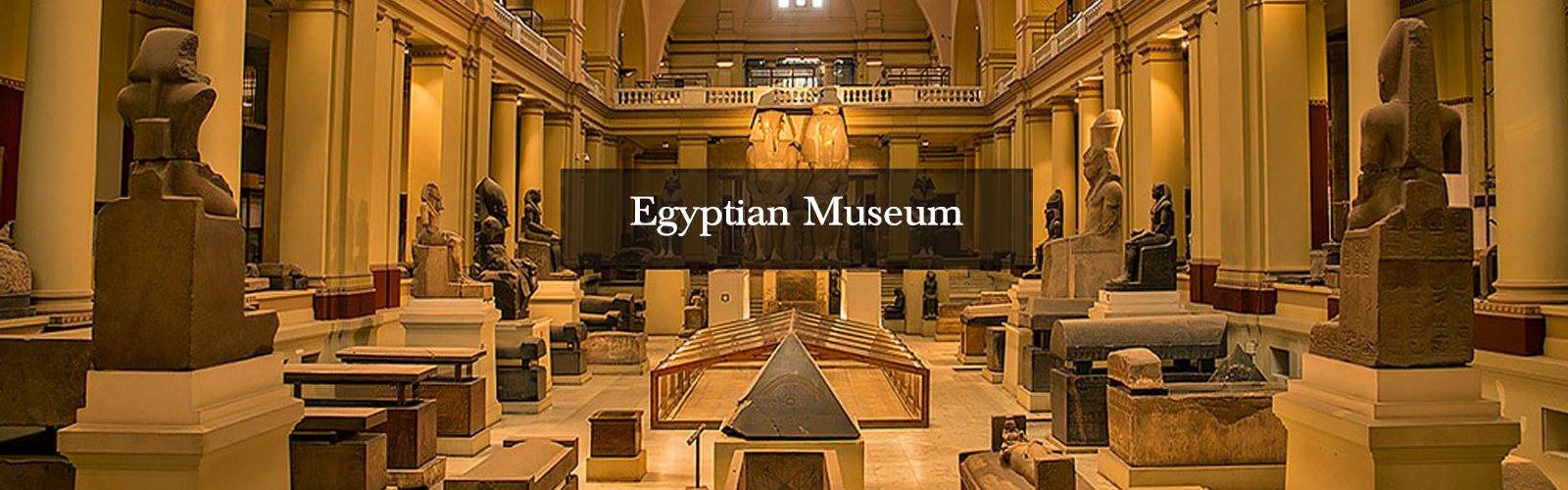
The Egyptian Museum

Square

THE EGYPTIAN MUSEUM, Since 1902

WELCOME TO THE
EGYPTIAN MUSEUM IN CAIRO (EMC)
Discover the world’s largest collection of Egyptian antiquities

The Egyptian Museum in Cairo (EMC) is the oldest archaeological museum in the Middle East, housing over 170,000 artefacts. It has the largest collection of Pharaonic antiquities in the world.

The Museum’s exhibits span the Pre-Dynastic Period till the Graeco-Roman Era (c. 5500 BC – AD 364)..

The Egyptian Museum in Cairo is situated on the northeast of the centrally located Tahrir Square. It is one of the largest museums in the world, and the first national museum in the Middle East. It is actually the fifth building to house Egyptian antiquities, and has had a long and illustrious history until today.

The architect of the building was selected through an international competition in 1895

which was the first of its kind, and was won by the French architect, Marcel Dourgnon. The museum was inaugurated in 1902 by Khedive Abbas Helmy II, and has become a historic landmark in downtown Cairo, and home to some of the world’s most magnificent ancient masterpieces.

Among the museum’s unrivaled collection are the complete burials of Yuya and Thuya, Psusennes I and the treasures of Tanis, and the Narmer Palette commemorating the unification of Upper and Lower Egypt under one king, which is also among the museum’s invaluable artifacts. The museum also houses the splendid statues of the great kings Khufu, Khafre, and Menkaure, the builders of the pyramids at the Giza plateau. An extensive collection of papyri, sarcophagi and jewelry, among other objects, completes this uniquely expansive museum.

Historical background of the Egyptian Museum

The idea of a museum for Egyptian antiquities in Egypt goes back to Muhammad Ali Pasha, who was viceroy of Egypt from 1805 to 1848. Attempting to put an end to the export of antiquities, he issued a decree on the 15th of August 1835, which resulted in the first Egyptian museum for antiquities in Cairo. Housed in a building near El-Ezbekia Garden, the display was designed by Hakikan Effendi, and the collection was managed by Youssef Diaa Effendi. At the same time, Sheikh Rifa’a al-Tahtawi, who was responsible for the excavation and conservation of Egyptian monuments, also ordered that no further excavations be undertaken without his permission. He announced that the export of artefacts from Egypt was strictly forbidden, and that all finds were to be transported to the El-Ezbekia Museum.

In 1851, during the reign of Abbas I, the entire collection was transferred from El-Ezbekia to one of the halls within the Citadel of Salah El-Din (Saladin), where it was accessible only to private visitors. However, in 1854, most of the objects were gifted to Austria’s heir to the throne, Archduke Maximilian, who had shown great interest in them during his visit to Egypt. They now represent a major part of the Egyptian collection in the Kunsthistorisches Museum in Vienna.

The Boulaq Museum

In 1858, the viceroy Said Pasha appointed the French Egyptologist Auguste Mariette as Director of a new museum in the Boulaq area of Cairo. Mariette had been sent on a mission to Egypt by the Louvre Museum and had quickly made important discoveries, including the catacombs of the Serapeum in Saqqara. This museum building had originally accommodated the Nile Navigation Company at the Boulaq Harbour, now located close to the State Television Building and the Ministry of Foreign Affairs.

In 1859, after the discovery of the funeral equipment of Queen Ahhotep at Dra’ Abu el-Naga in Thebes, the Pasha granted funds to enlarge the building. The formal inauguration of the Boulaq Museum took place on the 18th of October 1863, and was attended by Khedive Ismail. However, the museum quickly became too small to house all of the artefacts that continued to be added to the original collection, and by 1869 the building was enlarged once again. Disastrous Nile floods in 1878 resulted in serious damage to the museum and it remained closed to the public for repair, until its reopening in 1881. The possibility of future flooding, along with the 1881 discovery of the cache of royal mummies at Deir el-Bahari, made it apparent that the museum needed new quarters.

During the same year, Mariette passed away, and he was succeeded by the French Egyptologist of Italian origins, Gaston Maspero, as Director of the Boulaq Museum and Department of Antiquities. By 1890, the overall size of the collection had increased beyond the Boulaq Museum’s ability to contain an ever-growing number of objects. In response to this, the entire collection was transferred to the Ismail Pasha Palace in Giza, located in the area of the present-day Giza Zoo.
The interior architecture of the Boulaq Museum
Ismail Pasha Palace in Giza

Unfortunately, the Ismail Pasha Palace was not adapted to function as a museum, especially for the exhibition of monumental sculptures. The need for a new museum became even more urgent when a cache of 21st Dynasty coffins and mummies of the priests and priestesses of Amun was discovered in Bab el-Gusus, at Deir el-Bahari, during the same year. The Ismail Pasha Palace was neither secure nor large enough to house the hundreds of objects regularly arriving from excavations. Furthermore, the palace lacked space for laboratories, a library, and administrative offices, which made it difficult to establish a well-functioning institution.

Historical background of the Egyptian Museum

Eis a combination of labyrinthine alleys that are truly like a time capsule able to contain a great amount of pure ancient art, magic, and absolute wonder. It’s where the various monumental religious complex was constructed during the Mamluk period in the reign of Sultan Al- Ghuri “Khan El Khalili Bazaar in 1501-1516“. The bazaar of Khan El Khalili contains an ornate gate and upper stories whose exterior is lined with iron-grilled windows and two monumental doors that are still holding their ground till today.

Marseille.

the Marseille sculptor Ferdinand Faivre was commissioned to create the two large statues whcih flank the main door representing Upper and Lower Egypt. The cornerstone of the Egyptian Museum was laid on the 1st of April 1897, in the presence of Khedive Abbas Hilmy. On the 7th of May 1900, after three years of work, the first artefacts were placed in the showcases. Scientific supervision and the task of setting up the collection was entrusted to Gaston Maspero

Leave a Reply

Your email address will not be published. Required fields are marked *