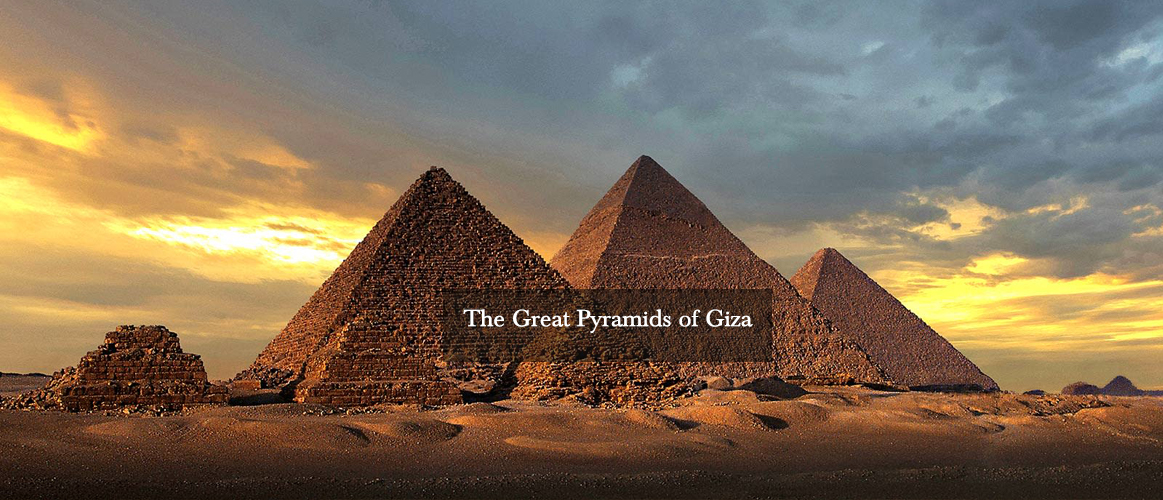
The Great Pyramids of Giza

Square

The Great Pyramids of Giza

WELCOME TO THE
EGYPTIAN The pyramids of Giza

The pyramids of Giza and the Great Sphinx are among the most popular tourist destinations in the world, and indeed already were even in Roman times. Each of these spectacular structures served as the final resting place of a king of the 4th Dynasty (c.2613–2494 BC). The Great Pyramid of Giza was built for king Khufu (c.2589–2566 BC), and the other two for Khafre and Menkaure, his son and grandson. Khufu’s pyramid is both the oldest and largest of the three, and the first building to exceed it in height would not be built for another 3,800 years!

Although the three pyramids dominate the plateau, they are in fact surrounded by many other monuments. Every king’s pyramid was just one element albeit the most important of a larger complex that included smaller, subsidiary, queens’ pyramids; an additional one that acted as a second, symbolic, tomb for the king, called a satellite pyramid; mastaba tombs for nobility and other family members; burials of actual and/or symbolic boats; and a pair of temples linked by a richly decorated causeway. One of these temples, called the valley temple, led into the pyramid complex, and was located on or near a body of water where boats could dock. The other, the funerary (or upper) temple, stood near the base of the pyramid. Priests maintained the mortuary cult of the deceased king in these temples, where his divine aspect was worshiped, and where rich and diverse offerings were presented to his soul so he could have a peaceful and luxurious afterlife.

The Great Pyramid, the tomb of King Khufu (c.2589–2566 BC)

, with its original height of 146.5 meters, was the tallest structure in the world for 3,800 years. It remains the last surviving member of the Seven Wonders of the Ancient World, and took an estimated 10 to 20 years to build. To this day, it is not entirely certain how this was done.

The Great Pyramid is made of local limestone, but its exterior was once entirely covered with high quality limestone. These casing stones were brought from Turah, south of Maadi, by ship. On the inside, the pyramid has three chambers, one cut into the bedrock underneath, and two high up within the masonry itself, a feature that no other pyramid possesses. The sarcophagus in which Khufu was once laid to rest can still be seen in the upper of these two rooms, the King’s Chamber. This room is accessed through the Grand Gallery, a majestic corbelled ascending passage, and a masterpiece of ancient engineering and architecture.

Two large and impressive ships were discovered in pits on the south side of the pyramid in a dismantled state. These are believed to have been used to transport the royal mummy and burial equipment to the tomb.

.

Historical background of the Egyptian Museum

T

””””””””””””””

The Great Pyramid of Giza

T
he Great Pyramid of Giza is the largest Egyptian pyramid. It served as the tomb of pharaoh Khufu, who ruled during the Fourth Dynasty of the Old Kingdom. Built c. 2600 BC over a period of about 27 yearsthe pyramid is the oldest of the Seven Wonders of the Ancient World, and the only wonder that has remained largely intact. It is the most famous monument of the Giza pyramid complex, which is part of the UNESCO World Heritage Site “Memphis and its Necropolis”.[5] It is situated at the northeastern end of the line of the three main pyramids at Giza.

Initially standing at 146.6 metres (481 feet), the Great Pyramid was the world’s tallest human-made structure for more than 3,800 years. Over time, most of the smooth white limestone casing was removed, which lowered the pyramid’s height to the current 138.5 metres (454.4 ft); what is seen today is the underlying core structure. The base was measured to be about 230.3 metres (755.6 ft) square, giving a volume of roughly 2.6 million cubic metres (92 million cubic feet), which includes an internal hillock.[6] The dimensions of the pyramid were 280 royal cubits (146.7 m; 481.4 ft) high, a base length of 440 cubits (230.6 m; 756.4 ft), with a seked of 5+


The Great Pyramid was built by quarrying an estimated 2.3 million large blocks, weighing 6 million tonnes in total. The majority of the stones are not uniform in size or shape, and are only roughly dressed.The outside layers were bound together by mortar. Primarily local limestone from the Giza Plateau was used for its construction. Other blocks were imported by boat on the Nile: white limestone from Tura for the casing, and blocks of granite from Aswan, weighing up to 80 tonnes, for the “King’s Chamber” structure.


There are three known chambers inside of the Great Pyramid. The lowest was cut into the bedrock, upon which the pyramid was built, but remained unfinished. The so-called[9] Queen’s Chamber and King’s Chamber, which contain a granite sarcophagus, are above ground, within the pyramid structure. Hemiunu, Khufu’s vizier, is believed by some to be the architect of the Great Pyramid.[10] Many varying scientific and alternative hypotheses attempt to explain the exact construction techniques, but, as is the case for other such structures, there is no definite consensus.


The funerary complex around the pyramid consisted of two mortuary temples connected by a causeway (one close to the pyramid and one near the Nile); tombs for the immediate family and court of Khufu, including three smaller pyramids for Khufu’s wives; an even smaller “satellite pyramid”; and five buried solar barges


The interior of Pyramids is the greatest mystery in the world.
A long time ago, Egyptians built the great pyramid of Giza. What is inside the pyramid is still a mystery and people are searching for it by using modern technology.

There are many chambers inside the pyramid. But three main chambers were found inside of it, King’s chamber, Queen’s chamber, and Grand gallery. But no mommies are still not found inside these galleries. From the entrance, a man can visit all the chambers including the subterranean chambers. But the purpose of subterranean chambers is still unknown. Some say that these were for making mazes around the three main chambers.

If a man enters from the queen’s chamber he can roam all three main chambers.But if someone enters from the king’s chamber,he can only visit the king’s chamber.It was small and lined, like other kings’ chambers, with thick granite blocks. The space would have been very austere, as Egyptians only began decorating burial chambers with hieroglyphic texts in later pyramids.

the Pyramids of Giza, like the Egyptian pyramids that came before and after them, were royal tombs, a final resting place for their pharaohs, or kings. They were often part of an extensive funerary complex that included queens’ burial sites and mortuary temples for daily offerings. The pharaoh’s final resting place was usually within a subterranean burial chamber underneath the pyramid. Although the Great Pyramid has subterranean chambers, they were never completed, and Khufu’s sarcophagus rests in the King’s Chamber, where Napoleon is said to have sojourned, deep inside the Great Pyramid.

The Eastern and Western Cemeteries are
two of the largest preserved Old Kingdom cemeteries form a part of the pyramid compl

The cemeteries consist mostly of mastabas, but rock-cut tombs are attested as well. The term mastaba (Arabic for “bench”) refers to a type of funerary structure that was generally rectangular in shape and built over the tomb proper, which was underground. Most of the mastabas of the Eastern and Western Cemeteries were built during the reign of Khufu, in tandem with his pyramid complex, whereas the rock-cut tombs were for the most part built later.

Most of the tombs of the Eastern Cemetery dating to the reign of Khufu were intended for his closest relatives. The rock-cut tomb of his mother, queen Hetepheres I, along with her funerary equipment, was discovered here, and it is the site of the mastaba of his half-brother Ankh-haf, who had an important administrative position in the construction of the Great Pyramid. On the other hand, the mastabas of the Western Cemetery, which are mostly arranged in an orderly grid, were reserved for very high-ranking noblemen that were not as closely related to the king. Among them is the monumental mastaba of Hemiunu, who oversaw the building of the Great Pyramid

Under the shadow of the Great Pyramid lies the mastaba of Queen Meresankh III, the wife of Khafre and granddaughter of Khufu. Both very large and exquisitely decorated, this is indeed a tomb worthy of her rank and fortunately also contains the best preserved wall reliefs in the Eastern Cemetery.

These are decorated with a diverse array of scenes, including bread baking, beer brewing, fowling, herding, mat making, metal smelting, and the sculpting of statues, apparently of Meresankh herself. These, along with the elaborate scenes of offering-bearers bringing all sorts of gifts to Meresankh, were intended to magically provide her soul with a continuous stream of food and goods in the afterlife. Interestingly, among the objects being brought to her are a canopy with a bed being set up within it, an armchair, and a carrying chair. Actual examples of very similar objects were discovered in the tomb of Hetepheres I, the mother of Kufu, and can be seen today at the Egyptian Museum in Cairo.

Among the most striking features of Meresankh’s tomb chapel is a series of ten large statues of women that are carved out of the northern wall. It is believed that they represent, in addition to Meresankh herself, her mother, and daughters as well.

Marseille.

The Secrets Hidden in the Pyramids and Sphinx
On November 10th, 1993, an hour-long documentary titled ‘The Mystery of The Sphinx‘ was broadcast in primetime on NBC to some 30 million viewers across the United States. The documentary, which would go on to win an Emmy award for its work, detailed a series of geological and seismic surveys conducted around the Giza Plateau between 1991 and 1993 by a team of Egyptologists led by John Anthony West.

What West and his team had discovered during these surveys stunned the viewing audience.
According to geological evidence, the Sphinx was not 4,500 years old, as was commonly accepted, but much older, in fact, over 10,000 years old, dating back well before the rise of Egyptian civilization as we know it. Further, seismic surveys showed a vast expanse of unexplored tunnels and chambers underneath the Sphinx, stretching deep underground. Documentary viewers and historians across the world wondered what this could mean, what secrets could be hidden in these unexplored depths.
That same year, another team, led by German robotics engineer Rudolf Gantenbrink, sent a small robot equipped with a camera down an unexplored 8-by-8-inch shaft within the Great Pyramid.

The robot crawled slowly for 200 feet, until it reached a startling impasse, what appeared to be a door made of limestone or marble. More incredibly, the door seemed to have two copper handles on it. Metal, such as copper, is not found anywhere else in the Great Pyramid, leaving Gantenbrink and his team to wonder if they were in fact handles, or perhaps keys, or something else entirely. More importantly, they wondered, what could be behind this door?

Mysterious Discoveries around the Giza Plateau
The question of what might be hidden under the pyramids did not start with John Anthony West and Rudolf Gantenbrink.

Records show that in 1817, the British Counsel General to Egypt, Sir Henry Salt, alongside the rogue Italian explorer Giovanni Caviglia, discovered a large tomb just west of the Great Pyramid, which opened up to a maze of subterranean passages. Unfortunately, these men were not historians and abandoned exploration of the passages when they found them devoid of the treasure they were hunting.

Leave a Reply

Your email address will not be published. Required fields are marked *